

Xiamen Juda Chemical & Equipment Co., Ltd. is one of the leading manufacturers and suppliers of Heptafluoropropane: HFC Fire Extinguisher Gas for Occupied Protected Enclosures in China. If you are looking for Heptafluoropropane: HFC Fire Extinguisher Gas for Occupied Protected Enclosures, please be free to buy our quality products at competitive price from our factory. Contact us for quotation.
Specifiers and fire protection installers keep returning to heptafluoropropane as a proven gaseous fire control option for rooms where water damage or powder residue would create costly secondary losses. This HFC fire extinguisher gas, formally named 1 1 1 2 3 3 3 heptafluoropropane, is traded widely under the FM200 brand name. Unlike many suppression media that work mainly by displacing oxygen, heptafluoropropane gas interrupts the chemical reaction of combustion while absorbing heat from the flame zone. This product write-up focuses on field-side practical points that engineers and bulk buyers weigh up when comparing heptafluoropropane against other clean agents, with less focus on full system hardware and more on the gas itself.
Core Chemical and Physical Traits of heptafluoropropane
1 1 1 2 3 3 3 heptafluoropropane belongs to the hydrofluorocarbon family, engineered for fire protection use rather than refrigeration duties. It is shipped as a liquefied compressed gas inside certified cylinders and turns into vapour quickly once released into a closed space.
1. It is colourless and carries no distinct smell, so site teams cannot rely on scent to detect an accidental release without proper gas detectors fitted on site.
2. It is electrically non-conductive, making it safe around live electrical hardware when deployed at design extinguishing concentrations.
3. Vapour density sits higher than air, which means enclosure sealing becomes critical; poorly sealed rooms will let the gas sink and leak out before it can hold the concentration needed to knock down a fire.

How Heptafluoropropane Stops Fire
Many buyers new to this HFC fire extinguisher gas mistakenly assume it works like inert gas by pushing oxygen out. The mechanism for heptafluoropropane operates differently, and this difference shapes its design limits.
Heat absorption takes the first role: the liquid droplets flash to gas and pull thermal energy away from the flame, dropping temperature below the combustion threshold.
Chemical chain inhibition breaks free radicals that sustain burning. This action is why it achieves extinguishment at lower volume concentrations than most inert gas agents.
It acts rapidly. Most approved designs target full concentration build-up within 10 seconds, which limits fire spread and reduces thermal harm to sensitive equipment in the room.
Where Project Teams Select Heptafluoropropane
Heptafluoropropane fits sites where downtime and asset preservation are top priorities. We see consistent demand from these verticals across our global fluorochemical supply channels:
Telecom shelters and remote communication sites, where on-site maintenance is infrequent and water discharge would disable core transmission gear.
Medical equipment storage and diagnostic imaging rooms, housing expensive calibrated devices that cannot tolerate powder, foam or water contact.
Small generator enclosures and battery control rooms with sealed boundaries, where a compact clean agent package is preferred over large tank banks for inert gas.
High-value manufacturing test bays and metrology labs, where residue left by suppression media would contaminate samples or precision tooling surfaces.
Cross-Material Compatibility Guidance for Heptafluoropropane
While heptafluoropropane is chemically stable under normal storage and discharge temperatures, facility designers still need to check compatibility with seals, gaskets and internal wiring insulation used within the protected zone. Long-term contact with certain elastomers can cause swelling, hardening or gradual degradation.
1.Fluorosilicone, EPDM and Viton seals show good resistance to pure heptafluoropropane and are widely specified for cylinder valves, piping joints and damper seals.
2.Some common nitrile rubber and low-grade PVC insulation may swell or lose flexibility after repeated exposure to vaporised heptafluoropropane. This is a slow ageing effect, not immediate failure.
3.Most metal materials including carbon steel, stainless steel, copper and aluminium work well with this agent, as long as moisture levels in the gas stay within certified limits. Excess water content is the main trigger for metal corrosion, not the heptafluoropropane itself.
Physical & Chemical Properties
|
Attributes |
Values |
|
Chemical name |
HFC-227ea, Heptafluoropropane, 1,1,1,2,3,3,3-Heptafluoropropane |
| Chemical formula | CF3CHFCF3 |
| Molecular formula | C3HF7 |
| CAS No. | 431-89-0 |
| ODP | 0 |
| GWP100 yr | 3220 |
| Atmospheric lifetime(years) | 34 |
| Molecular weight | 170.03 |
|
Boiling point (℃) |
-16.4 |
|
Freezing point (℃) |
-131 |
|
Critical temperature (℃) |
101.7 |
|
Critical pressure (kPa) |
2925 |
|
Vapor pressure (kPa, @25℃) |
454 |
|
Liquid density (g/ml, @25℃) |
1.39 |
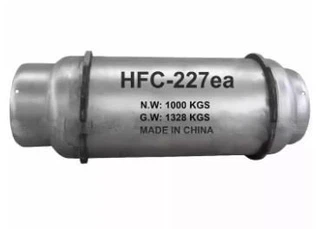
bulk Heptafluoropropane packaging

30lb/13.6kg Disposable cylinder

1000 Ton Cylinder

22 Ton ISOTANK
Factory Tour


Hot Tags: Heptafluoropropane: HFC Fire Extinguisher Gas for Occupied Protected Enclosures, suppliers, manufacturers, factory, quotation, price, buy, R23, Safe Fire Extinguishers, Hfc 236fa, Halon 1301 Replacement, Fire Extinguisher Chemicals, Halon 1211 Replacement