


As grid-scale renewable energy deployment accelerates, containerized and rack-based Battery Energy Storage Systems (BESS) have become critical for grid stabilization, peak shaving, and commercial backup power. However, thermal management remains one of the most stubborn technical and safety bottlenecks for modern lithium-ion BESS. Uneven temperature distribution, hotspot accumulation, and thermal runaway propagation continue to cause accelerated battery degradation, operational risks, and high long-term maintenance costs.
Traditional air cooling and indirect liquid cooling solutions can maintain basic thermal control, but they struggle to deliver uniform heat dissipation under high-rate charge and discharge cycles. In recent years, BESS immersion cooling using dielectric fluids has emerged as a next-generation thermal management method to address these pain points. Among various dielectric options including synthetic esters, silicone oils, and hydrofluoroethers, PFPE (Perfluoropolyether) stands out as a high-performance dielectric fluid designed for rigorous energy storage environments. While immersion cooling delivers clear safety and lifespan advantages, it also comes with inherent limitations and tradeoffs. This article objectively analyzes how PFPE immersion cooling improves BESS safety and ROI, as well as its existing challenges for real-world projects.
How Immersion Cooling Works for BESS Thermal Management
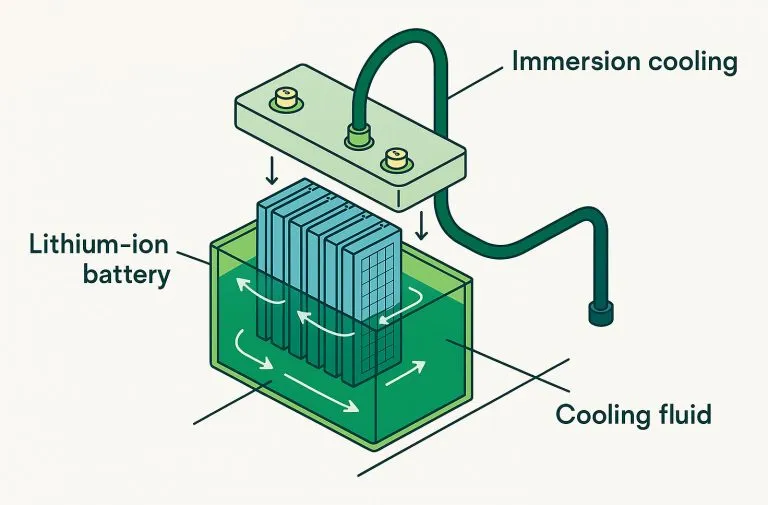
Unlike air cooling that relies on forced air convection or indirect cold-plate liquid cooling that only contacts battery surfaces externally, immersion cooling fully submerges battery cells, modules, busbars, and connectors inside stable dielectric fluid. The non-conductive liquid directly contacts every component, absorbing heat uniformly and minimizing inter-cell thermal gradients. This direct heat transfer mechanism effectively reduces localized hotspots, which are the primary triggers of uneven battery aging and early thermal failure.
High-quality dielectric fluids such as PFPE feature stable thermal capacity and excellent insulating properties, allowing consistent heat dissipation even under high-power cycling and extreme ambient temperatures. Compared with air cooling systems that consume high auxiliary power and generate persistent temperature deviations, immersion cooling lowers fan energy consumption and supports more stable long-term BESS operation. For this reason, immersion cooling is increasingly adopted for utility-scale BESS, high C-rate systems, and projects deployed in tropical or desert high-temperature regions.
Key Safety Benefits of PFPE Dielectric Fluid for BESS Immersion Cooling
Safety enhancement is the core driver for the growing adoption of PFPE immersion cooling. As a fully fluorinated synthetic dielectric fluid, PFPE provides reliable electrical insulation and thermal stability that outperforms most conventional cooling mediums.

1.First, PFPE delivers superior dielectric performance with high breakdown voltage and ultra-low conductivity, eliminating short-circuit risks caused by fluid contact with high-voltage electrical components. This makes it far safer than water-glycol indirect cooling solutions, which carry potential leakage and conductivity hazards.
2.Second, PFPE features excellent thermal stability and non-flammable characteristics within normal BESS operating ranges. When local cell overheating occurs, the surrounding PFPE fluid absorbs excess heat rapidly, slowing temperature rise and reducing the probability of thermal runaway initiation. In scenarios where single-cell failure inevitably occurs, PFPE fluid helps suppress flame formation and slow down thermal propagation, effectively limiting fault spread and reducing the risk of catastrophic system-level fires.
3.Third, PFPE exhibits outstanding chemical inertness. It does not react with copper, aluminum, plastic, rubber, or battery sealing materials, avoiding component corrosion, fluid deterioration, or sludge accumulation commonly seen with mineral oil cooling systems. This stable material compatibility supports longer service cycles and reduces hidden safety risks caused by fluid degradation.
Real ROI Improvements Enabled by PFPE Immersion Cooling
Beyond safety upgrades, PFPE immersion cooling brings measurable economic benefits that improve overall BESS lifecycle ROI. The uniform temperature control maintains inter-cell temperature differences within a minimal range, significantly reducing lithium plating and capacity attenuation during long-term operation. Consistent thermal stability helps extend battery cycle life and delay core asset replacement, which is the largest contributor to long-term project profitability.
In terms of operational costs, immersion cooling reduces reliance on high-power cooling fans, lowering auxiliary power consumption throughout the system's lifespan. Meanwhile, PFPE's ultra-low volatility minimizes fluid evaporation loss, reducing the frequency of fluid refilling compared with HFE and traditional fluorinated fluids. Its long-term stability also decreases system cleaning and maintenance workload, effectively cutting annual OPEX for BESS asset owners.
Additionally, optimized thermal performance and improved thermal runaway resistance help projects comply with stricter BESS safety standards including NFPA 855 and UL 9540A, reducing potential safety rectification costs and lowering long-term insurance premium risks.
Honest Limitations & Challenges of PFPE Immersion Cooling
To maintain objective technical authenticity and industry credibility, it is essential to recognize the existing limitations and challenges of PFPE immersion cooling, just as with all emerging BESS thermal management technologies.
First, higher upfront capital cost. PFPE dielectric fluid is a high-grade specialty fluorochemical material, which is more expensive than mineral oil, synthetic esters, and water-glycol solutions. Immersion cooling systems also require sealed container structures, fluid circulation units, and leakage monitoring devices, resulting in higher initial investment compared with traditional air-cooled BESS solutions.
Second, increased system weight. Dielectric fluid immersion adds overall container weight, which may impact transportation limits and container energy density for certain projects with strict loading restrictions.
Third, higher maintenance complexity. Immersion systems require regular monitoring of fluid purity, water content, and potential contamination. Fluid leakage, though rare with qualified PFPE products, remains a systematic risk that requires professional containment design and routine inspection mechanisms.
Fourth, limited long-term field operation data. While PFPE material itself is chemically mature, large-scale long-term UL 9540A field verification and decade-level failure mode data for full immersion BESS systems are still accumulating across the industry. As an emerging thermal solution, it still requires continuous project iteration and data verification.
Who Should Choose PFPE Immersion Cooling for BESS?
PFPE immersion cooling is not a one-size-fits-all solution, but it offers the best balanced performance for high-standard BESS projects. It is most suitable for utility-scale energy storage, high C-rate peak-shaving systems, tropical and desert high-temperature scenarios, and projects pursuing long lifecycle safety and low long-term failure rates. For small-scale low-power BESS, air cooling or indirect liquid cooling may remain more cost-effective choices in the short term.

One-stop PFPE dielectric fluid supplier in China
THE NEXT GENERATION of BESS COOLING
PROTECT PERFORMANCE
PREVENT FIRE
PFPE dielectric fluid immersion cooling represents one of the most promising thermal management upgrades for next-generation battery energy storage systems. It delivers uniform cooling efficiency, reliable thermal runaway suppression capability, stable material compatibility, and clear long-term ROI improvement. However, higher upfront costs, increased system weight, maintenance complexity, and incomplete long-term industry data remain realistic challenges for large-scale universal adoption.
As a professional PFPE dielectric fluid supplier focusing on BESS immersion cooling applications, we provide high-purity, stable perfluoropolyether fluids optimized for energy storage thermal management. We remain objective and technical-focused, helping clients evaluate cooling solution tradeoffs and select the most cost-effective thermal safety design for their specific BESS projects. Contact us for professional fluid parameters, compatibility testing reports, and project customization support.


