

As global HVAC industry accelerates low-GWP refrigerant transformation under the Kigali Amendment and EU F-Gas Regulation, HVAC OEMs, factory procurement teams and equipment designers face three core pain points when choosing between R410A and R32 refrigerant:
1.Can switching from R410A to R32 cut long-term production and operating costs?
2.Which refrigerant fully meets export compliance standards for EU, Southeast Asia and North America?
3.What safety and structural adjustments are required for mass production lines?
This article delivers procurement-oriented, data-driven comparison between R410A and R32 refrigerant. We sort out performance gaps, environmental risks, safety classifications and manufacturing adaptability to help B2B buyers make cost-effective, future-proof procurement decisions.
Basic Overview: What Are R410A & R32 Refrigerant?
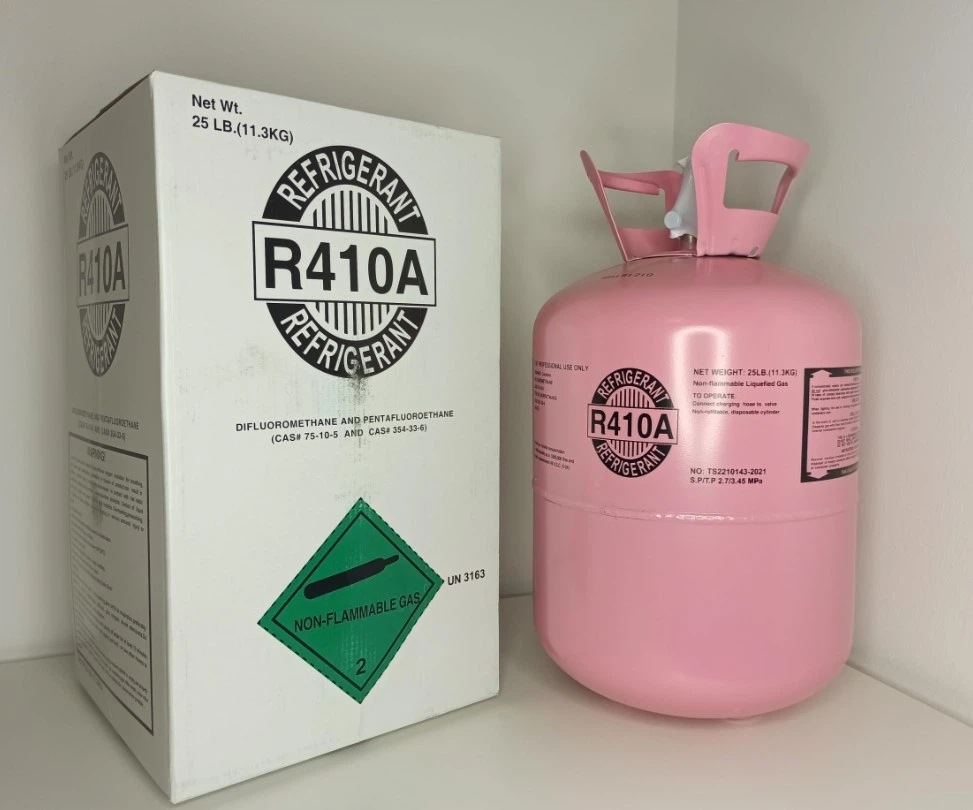
1.R410A Refrigerant
R410A is a classic blended HFC refrigerant composed of 50% R32 (Difluoromethane) and 50% R125 (Pentafluoroethane), with CAS No.75-10-5 & 354-33-6, UN3163.
ODP = 0, no ozone layer damage
A1 safety rating: non-flammable, low installation threshold
Mature application history in residential & commercial air conditioning
Critical flaw: Extremely high GWP of 2088, facing global phase-down restrictions

2.R32 Refrigerant
R32 (Difluoromethane, CAS 75-10-5, UN3252) is single-component HFC refrigerant recognized as mainstream next-generation low-GWP cooling medium.
Zero ozone depletion potential
GWP only ~675, 68% lower than R410A
Higher volumetric cooling capacity, less filling volume required
A2L low flammability grade, compliant with updated international HVAC safety codes
Pure single-component formula, easier recovery and recycling for mass production
Side-by-Side Technical Comparison Table
| Comparison Dimension | R410A Refrigerant | R32 Refrigerant | B2B Procurement Value |
|---|---|---|---|
| Composition | HFC mixed blend (R32+R125) | Single-component HFC | R32 simplifies recycling & inventory management |
| ODP | 0 | 0 | Both eco-friendly to ozone layer |
| GWP Value | 2088 (High) | ~675 (Low) | R32 avoids export carbon tariffs & regulatory limits |
| Cooling Capacity | Standard volumetric output | 20%-30% higher per kilogram | Reduce refrigerant filling weight per air conditioner |
| Required Charge Volume | High | 20-30% less | Cut raw material cost for OEM mass production |
| Energy Efficiency (COP) | Good | Superior | Lower electricity consumption for end users, boost product competitiveness |
| Operating Pressure | High | Similar to R410A | No major pump structural redesign required |
| Safety Classification | A1 Non-flammable | A2L Low flammability | R410A saves safety transformation cost; R32 meets new global standards |
| Recycling Difficulty | Moderate (blend separation needed) | Easy (pure single component) | R32 lowers factory refrigerant recovery cost |
| Long-Term Regulatory Trend | Gradual global phase-down | Encouraged mainstream alternative | R32 realizes long-term export compliance |
Want a printable PDF version of this full R410A & R32 parameter comparison table, including MSDS and COA data?
Click to Get Free Technical Datasheet
In-Depth Performance & Operational Cost Analysis
1.Cooling Efficiency & End-User Power Consumption
R32 features stronger heat transfer efficiency and higher volumetric cooling capacity than R410A:
Reach target indoor temperature faster under the same heat exchanger size
Reduce continuous compressor load during long-term operation
Lift seasonal energy efficiency ratio of air conditioning units
For OEM manufacturers supplying residential and commercial HVAC equipment, R32-equipped products have obvious energy-saving selling points, which effectively improve market competitiveness and product premium space.
2. Lifecycle Cost Advantages of R32
Two core cost-saving benefits for mass production factories:
Less refrigerant filling: Each air conditioner requires 20%-30% less refrigerant, cutting raw material bulk procurement expenses significantly.
Lower operating cost for end customers: Reduced power consumption decreases post-sales complaint rate and improves brand reputation.
Large-scale HVAC manufacturers can achieve visible ROI within 1-2 years after switching production lines to R32 refrigerant.
Environmental Impact & Global Regulatory Compliance
1. GWP Gap Is The Core Dividing Line
R410A GWP: 2088, classified as high-carbon refrigerant
R32 GWP: ~675, far below the threshold of most regional low-carbon policies
2. Global Policy Requirements
EU F-Gas Regulation: Strictly limit the market share of high-GWP HFC refrigerants; high-GWP media will face import restrictions and extra carbon taxes in the next 5 years.
Kigali Amendment: All signing countries carry out staged HFC phase-down plans, R410A will be gradually eliminated from new HVAC equipment.
Southeast Asia & North America: Successively release low-GWP refrigerant promotion policies, products using R32 enjoy smoother customs clearance and market access.
Confused about different GWP limits for refrigerant exports to EU, US and Southeast Asia? Our professional chemical engineer provides free one-on-one export compliance consultation.
Submit Inquiry For Custom Regulatory Solution
Safety Classification & Production Design Adjustments
1.R410A (A1 Non-Flammable)
Zero flammability risk under all normal working conditions
No extra ventilation, leak detection or staff training required for production lines
Fully compatible with existing mature installation and maintenance standards Suitable for short-term equipment maintenance and small batch replacement projects without factory reconstruction plans.
2.R32 (A2L Low Flammability)
Only slightly flammable under extreme high-concentration closed environments, safe for mass production with standardized design:
Mandatory supporting adjustments for OEM production lines:
Optimize workshop ventilation systems
Install real-time refrigerant leak detection devices
Provide A2L refrigerant operation training for production technicians
All mainstream international HVAC safety codes (IEC, ISO) fully recognize standardized R32 systems, and most global home appliance brands have completed full-line switching.
System Design & Manufacturing Reference
1.R410A Production Lines
Mature, stable production process with huge existing market inventory
No additional safety transformation investment
Defect: Limited export potential, facing policy elimination risks in the long run Suitable for after-sales maintenance, local market short-cycle replacement projects.
2.R32 Production Lines
Minor optimization of heat exchanger structure is needed
One-time safety facility transformation cost required
Long-term policy-compliant, supporting global export business All new HVAC product platforms developed by top OEMs adopt R32 as standard refrigerant to avoid repeated mold and line reconstruction in the future.
Clear Selection Guide for B2B Buyers
Choose R410A Refrigerant If:
You only provide after-sales maintenance and refilling service for old air conditioning equipment
Your project is short-term, and local regulatory restrictions on high-GWP refrigerants are not tight
No budget for production line safety transformation in the short term
Choose R32 Refrigerant If:
You develop brand-new HVAC air conditioning products
Export business to EU, US and Southeast Asia accounts for main sales volume
You want to reduce raw material filling cost and improve product energy efficiency selling points
Long-term stable production layout is required to avoid future policy reconstruction costs
FAQ: R410A & R32 Refrigerant Procurement Frequently Asked Questions

Q1: Can R32 directly replace R410A without modifying air conditioning equipment?
Q2: What's the bulk price gap between R32 and R410A refrigerant?
Q3: Is R32 refrigerant allowed for export to the EU market?