
The core international regulations and conventions governing the refrigerant industry focus on protecting the ozone layer and addressing climate change. These primarily include the Vienna Convention for the Protection of the Ozone Layer, the Montreal Protocol and its Kigali Amendments, as well as the Paris Agreement and the Basel Convention. In addition, there are important regional regulations such as the EU's F-Gas regulations, collectively forming the global refrigerant regulatory system, Ozone Secr... The following is a detailed introduction:
I. Core International Conventions: Building the Cornerstone of Global Refrigerant Regulation
Global refrigerant regulation has evolved from "single ozone layer protection" to "coordinated governance of ozone and climate," forming a governance framework centered on multiple conventions.
1. The Vienna Convention for the Protection of the Ozone Layer: A Framework for Guidance
The Vienna Convention for the Protection of the Ozone Layer, signed in 1985, is the world's first multilateral framework convention for ozone layer protection. It does not set specific control targets; its core purpose is to establish an international cooperation platform, clarify the obligations of contracting parties, and lay the legal foundation for subsequent specific protocols.
2. The Montreal Protocol: A Core Implementation Tool for Ozone Layer Protection
Signed in 1987 and entering into force in 1989, the Montreal Protocol is a core international treaty for the refrigerant industry. Its 198 contracting parties have made it a universally ratified environmental treaty. Its core principle is the phased elimination of ozone-depleting substances (ODS) such as CFCs, HCFCs, and halons.
Through multiple amendments, the phase-out process has been accelerated, with differentiated timelines defined: developed countries began phasing out CFCs in 1995, and the global goal is to completely eliminate HCFCs by 2030. China joined in 1991 and achieved its CFC production and import elimination target ahead of schedule in 2007.
3. Kigali Amendments: Extending to Greenhouse Gas Control
The Kigali Amendments, adopted in 2016 and effective in 2019, brought hydrofluorocarbons (HFCs), which do not cause ozone damage but have high gas emissions (GWP), under control, making their emissions a key focus of climate governance.
The amendments set a phased roadmap for global HFC reduction: developed countries will take the lead, China belongs to the first group of developing countries. In 2024, HFC consumption and production will be frozen at baseline levels.By 2029, it will be reduced to 90% of the baseline. By 2045, it will be reduced to 20% of the baseline, drive the industry toward low-GWP refrigerants.
More details about Kigali Amendments
4.Supporting Conventions: Improving Life Cycle Management
The Paris Agreement included HFCs in greenhouse gas management, encouraging countries to strengthen emission control through the NDC mechanism and promote recycling and low-GWP alternative technologies, in conjunction with the Kigali Amendment.
II. Key Regional Regulations
The EU, the US and other economies have introduced stricter regional regulations, which affect the global industrial chain through trade and have become the core compliance threshold in the international market.
1. EU F-Gas Regulation (EU 2024/573): The world's strictest regional control
The EU F-Gas Regulation, which came into effect in 2024, upgrades the controls based on the Kigali Amendments, covering all types of fluorinated greenhouse gases and related products and equipment. Key measures include:
Upgrading the quota system, reducing HFC usage to 21% of the 2015 baseline by 2030, and phasing it out completely by 2050; expanding the scope of control, strengthening leakage prevention and recovery requirements at all stages, and using digital means to combat illicit trade. These are mandatory guidelines for entering the European market.
2. The U.S. Clean Air Act and EPA Regulations
The U.S. Clean Air Act authorizes the EPA to regulate refrigerants, aligning with international conventions and detailing domestic standards, including banning certain ODS, managing HFC quotas, and standardizing recycling processes. The EPA's SNAP program clearly defines scenarios where high-GWP refrigerants are prohibited, providing compliance guidance for technology selection.
III. Industry Transformation and Compliance Recommendations Driven by Regulations
The global refrigerant industry's evolution has always been driven by regulations. Currently, it is accelerating its transition to low-GWP products, with natural refrigerants such as HFOs, CO₂, and ammonia becoming mainstream, making the construction of recycling systems increasingly important.
Companies with global operations need to focus on three key compliance points: aligning with target market control indicators to circumvent trade barriers; developing low-GWP product production capacity and R&D; and establishing a full lifecycle compliance system to implement leak detection, recycling, and disposal requirements.
As a major producer and consumer of refrigerants, China's 2026 quota scheme focuses on "total volume control and structural optimization," reducing quotas for second-generation and optimizing third-generation refrigerants. In the future, companies with low-GWP product development and compliance capabilities will have a competitive advantage.
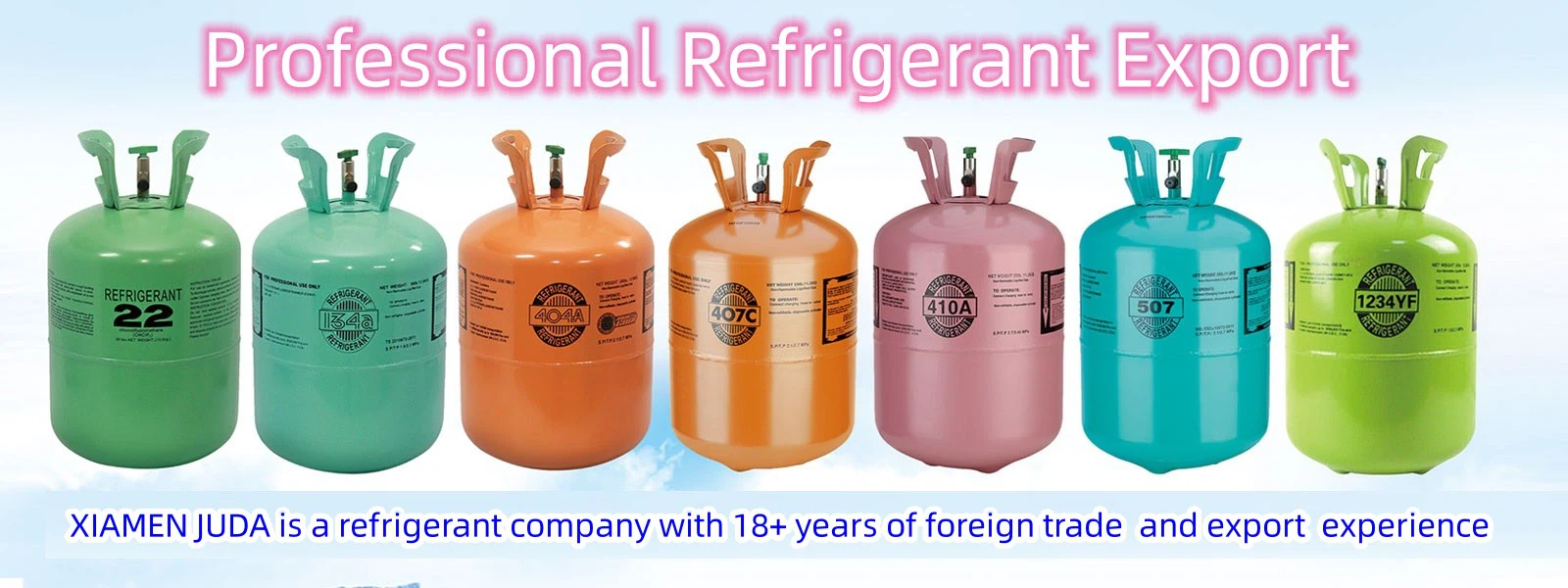
As a professional refrigerant supplier with years of industry expertise, we offer a comprehensive range of refrigerant products, including natural refrigerants (R600A, R290,etc) and conventional compliant varieties (R134A, R507A, R410A, R32,etc). These products are perfectly suited to meet the compliance requirements and application scenarios of different regions.
Backed by stable production capacity, stringent quality control, and professional technical support, we provide global customers with one-stop refrigerant solutions. Welcome to contact us for further cooperation.
Our address
Room 1102, Unit C, Xinjing Center, No.25 Jiahe Road, Siming District, Xiamen, Fujan, China
Phone Number
+86-592-5803997
susan@xmjuda.com